


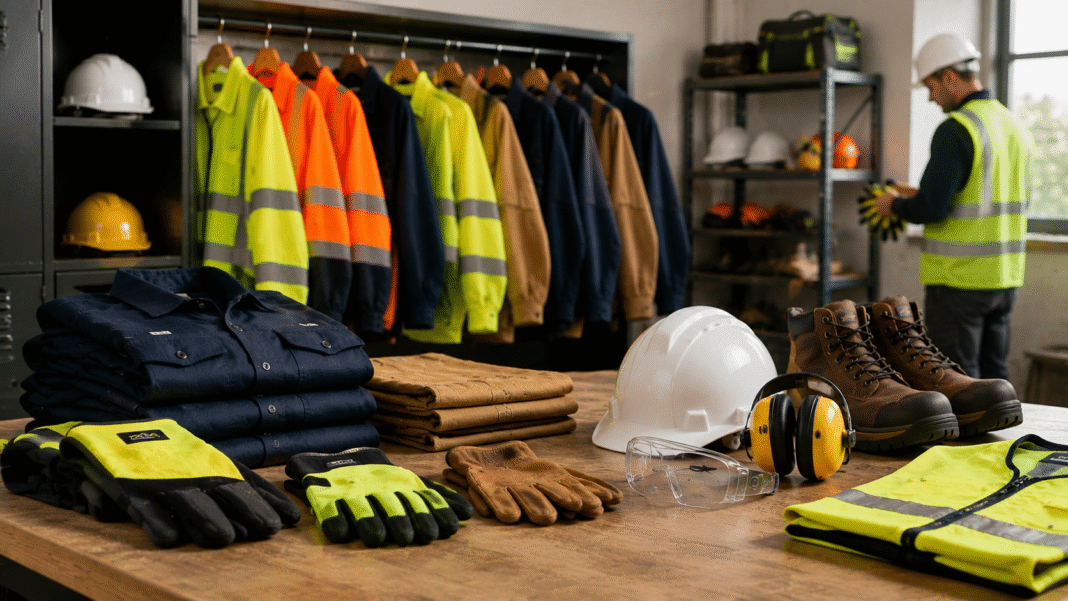

A workplace uniform program can be much more than a set of shirts bearing a company logo. For organizations operating in construction, manufacturing, utilities, maintenance, landscaping, transportation, warehousing, and other hands-on industries, uniforms may need to support employee safety, job performance, identification, comfort, and professional presentation at the same time.
That makes uniform planning a balancing exercise. A garment that looks professional may not provide adequate protection for a demanding job. A highly protective item may be uncomfortable enough that employees avoid wearing it correctly. Likewise, inexpensive apparel may reduce the initial purchasing budget but create higher replacement costs when it wears out quickly.
A well-designed program considers the entire employee clothing system rather than treating branding, workwear, and PPE as separate purchases. Masterman’s product range reflects this broader approach, covering workwear, high-visibility clothing, gloves, head protection, respiratory protection, rainwear, and other safety products alongside customization services.
Start With Job Hazards, Not the Company Logo
The first priority in a workplace uniform program should be the work employees actually perform.
A construction worker, warehouse associate, electrician, welder, landscaper, and office-based field supervisor may all represent the same organization, but their clothing requirements can be very different. Before selecting garments, employers should identify exposure to hazards such as impact, cuts, heat, flame, chemicals, weather, low visibility, dust, or repetitive physical movement.
This assessment determines which items belong in the uniform program and which should remain task-specific PPE.
For example, a standard work shirt might be appropriate for routine duties, while high-visibility garments may be necessary where employees work around vehicles or moving equipment. Masterman’s high-visibility range includes garments designed around ANSI/ISEA 107 classifications, including Class 2 and Class 3 options.
The trade-off is important: standardizing everything into one uniform can simplify purchasing, but it may result in unnecessary or inadequate protection. A better approach is usually to create a core uniform and then add role-specific protective equipment.
Build a Core Uniform Around the Work Environment
Once hazards have been identified, companies can establish a basic clothing package for each employee group.
A core package might include work shirts, durable pants, outerwear, footwear requirements, headwear, and seasonal layers. Depending on the industry, additional items could include high-visibility vests, rain gear, insulated clothing, protective sleeves, or specialized hand protection.
Durability should be considered alongside comfort. Heavy fabrics may withstand abrasion better, but excessive weight can increase fatigue during long shifts. Lightweight materials may improve comfort in warm environments but potentially require more frequent replacement.
The right choice therefore depends on the environment, workload, climate, laundering practices, and expected service life.
Companies should also consider how clothing behaves throughout a shift. Pockets, closures, ventilation, stretch, mobility, and fit can all affect productivity. A uniform that looks good when employees arrive at work but restricts movement during lifting, climbing, kneeling, or driving is not necessarily a successful uniform.
Treat PPE as a Separate but Connected Layer
One of the most common mistakes in uniform planning is assuming that branded workwear automatically qualifies as PPE.
Uniforms and protective equipment have different purposes. A branded shirt may identify an employee, while protective eyewear, gloves, hearing protection, respirators, fall protection, or specialized garments address specific workplace hazards.
For example, a company may select durable Leather Gloves for a task involving abrasion or handling requirements, but that decision should be based on the actual hazard assessment rather than the appearance of the glove or its compatibility with the company’s uniform colors.
The same principle applies to other protective equipment. Masterman’s PPE categories include hand, eye and face, head, hearing, respiratory, and fall protection, among others.
Connecting PPE with the uniform program can improve purchasing efficiency, but employers should not sacrifice protective performance for visual consistency.
Make High-Visibility Requirements Part of the Program
For organizations with employees working around vehicles, roadways, construction equipment, warehouses, or other visibility-sensitive environments, high-visibility clothing can be an essential part of the clothing system.
The important consideration is that visibility requirements should guide garment selection before branding decisions are made. Adding a logo should never interfere with required reflective elements or other safety features.
This creates another practical trade-off. A company may want a large, prominent logo, but the available placement area on a safety garment may be limited. The solution is to establish approved branding locations that preserve the garment’s functional characteristics.
Masterman’s high-visibility clothing collection includes vests, shirts, sweatshirts, jackets, pants, hats, and rain gear, with customization available on eligible products.
Choose Branding Methods According to the Garment
Branding is valuable because uniforms can help customers identify employees and create a consistent professional appearance. However, not every garment should be branded in the same way.
For shirts, hoodies, jackets, vests, and similar apparel, companies may use embroidered logos, printed graphics, name identification, or other forms of garment customization. Masterman’s in-house services include embroidery and custom screen printing for eligible workwear and high-visibility products.
The decision should consider fabric type, garment thickness, expected washing frequency, logo complexity, quantity, placement, and budget.
Embroidery can create a durable and polished appearance, although it may add weight or stiffness to lightweight garments. Printed graphics can provide flexibility for larger designs and may be more suitable for certain apparel styles. Neither option is universally better.
A good program establishes a consistent branding standard while allowing practical exceptions where safety, garment construction, or employee comfort takes priority.
Consider Employee Comfort and Fit
Employee acceptance can determine whether a uniform program succeeds.
Workers are more likely to consistently wear garments that fit properly, accommodate movement, and suit the conditions in which they work. Poor fit can create discomfort, distraction, restricted movement, or reluctance to wear required clothing.
Sizing should therefore cover the actual workforce rather than relying on a narrow range of standard sizes. Employers should also account for differences in body shape and consider both men’s and women’s workwear where appropriate.
Masterman’s workwear selection includes clothing designed for both men and women, including work shirts, pants, high-visibility garments, and other job-specific apparel.
Offering appropriate sizing may increase inventory complexity, but the alternative can be poor employee satisfaction and inconsistent uniform use. In many workplaces, that trade-off makes inclusive sizing worth the additional planning.
Plan for Seasonal and Environmental Conditions
A uniform program should account for the full working year.
Employees working outdoors may require breathable summer clothing, waterproof layers for wet conditions, insulated jackets for cold weather, and accessories such as winter hats or liners. Indoor industrial facilities may have different requirements depending on temperature, ventilation, and exposure risks.
Masterman’s seasonal offerings include high-visibility clothing, sweatshirts, winter hats, balaclavas, winter liners, winter gloves, and other cold-weather products.
A layered approach can be particularly effective because employees can adjust clothing according to changing conditions without replacing their entire uniform.
However, seasonal programs require additional inventory management. Companies must forecast demand, establish replacement schedules, and decide how much stock to keep available for new hires and unexpected replacements.
Establish Rules for Maintenance and Replacement
Buying uniforms is only the beginning. A workplace program should define how garments will be maintained and when they should be replaced.
Some organizations provide employees with replacement clothing when items become worn, damaged, contaminated, or no longer meet workplace requirements. Others use fixed replacement cycles.
Neither approach works equally well in every environment. A fixed schedule can simplify budgeting, while condition-based replacement can reduce unnecessary spending. However, relying entirely on visible wear may result in employees continuing to use garments beyond their intended service life.
The program should also clarify who handles laundering. Certain protective garments may have specific cleaning or care requirements, and employers should ensure that cleaning practices do not compromise their intended performance.
Think About Total Cost, Not Just Purchase Price
Uniform budgets often focus heavily on the price per garment. That can be misleading.
A lower-cost shirt that needs replacement twice as often may ultimately cost more than a durable alternative. Similarly, inexpensive outerwear may not provide sufficient weather protection, forcing employees to purchase additional layers or creating productivity problems.
Total cost should include purchase price, customization, shipping, replacement frequency, laundering, inventory storage, administrative time, and potential downtime associated with unsuitable products.
Bulk purchasing can improve unit economics, but excessive standardization creates its own risk. If a garment is ordered in large quantities before employees have tested it, the organization may be left with inventory that does not perform as expected.
Pilot programs and sample testing can reduce that risk.
Make Branding Work for Field Operations
Company branding has value beyond marketing.
When employees work at customer locations, branded apparel can make them easier to identify. This can be particularly useful for contractors, maintenance teams, delivery personnel, utility workers, and service technicians.
A consistent appearance can also reinforce professionalism and help customers distinguish authorized employees from other workers on a busy site.
However, branding should remain secondary to safety. Logo placement should not obscure reflective striping, warning information, identification markings, or other important garment features.
Companies should establish a simple visual standard covering logo size, placement, colors, employee names, job titles, and acceptable garment types. This prevents different departments from ordering inconsistent apparel.
Include an Ordering and Inventory System
A successful uniform program also needs an administrative structure.
Someone should be responsible for maintaining approved product lists, sizing information, logo files, vendor specifications, and replacement rules. The company should also determine who can place orders and how new employees receive their initial uniforms.
A centralized system can improve consistency and reduce duplicate purchases. Masterman’s customization process, for example, provides options for uploading company artwork and requesting customized workwear.
The challenge is avoiding excessive bureaucracy. If replacing a damaged shirt requires multiple approvals, employees may continue using unsuitable clothing simply because obtaining a replacement is inconvenient.
The best systems balance control with accessibility.
Review the Program Based on Real-World Performance
Uniform programs should not remain unchanged indefinitely.
Employers should periodically ask whether garments are holding up, whether employees find them comfortable, whether sizing is adequate, whether protective equipment remains appropriate, and whether branding still reflects the organization.
Feedback from workers is particularly valuable because procurement teams may evaluate cost and specifications while employees experience the garments for eight or more hours each day.
Replacement rates, complaints, damaged garments, purchasing costs, and PPE-related observations can also provide useful evidence.
The objective is not to create the most expensive uniform program. It is to create one that provides the appropriate protection, performs reliably, supports employees, represents the company professionally, and remains manageable over time.
The Right Uniform Program Balances Protection, Performance and Identity
A workplace uniform program works best when it is treated as an operational system rather than a clothing order. PPE requirements, workwear, seasonal protection, employee comfort, branding, inventory, maintenance, and replacement policies all influence the final outcome.
The biggest trade-off is rarely simply cost versus quality. It is the balance between safety, durability, comfort, employee acceptance, operational efficiency, and brand consistency.
Organizations that begin with job hazards and employee needs can then build a practical uniform structure around those priorities. Branding becomes a useful extension of the program rather than the reason for choosing a particular garment.
For businesses managing crews across demanding work environments, this approach can make uniform purchasing more predictable while ensuring that employees receive clothing and protective equipment suited to the work they actually perform. A supplier with both industrial safety products and customization capabilities can also simplify the process by reducing the number of separate purchasing relationships an organization must manage.