


In the healthcare industry, medical equipment plays a critical role in delivering accurate diagnoses, effective treatments, and quality patient care. From MRI machines and ventilators to infusion pumps and patient monitors, every piece of equipment must function reliably. Proper maintenance is essential not only to ensure operational efficiency but also to comply with healthcare regulations and improve patient safety.
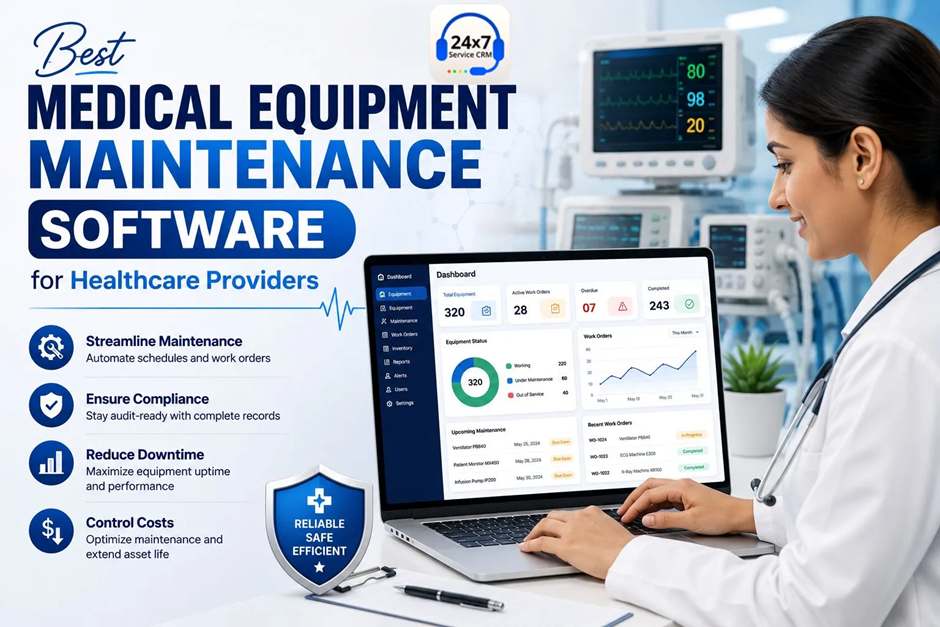
Managing hundreds or even thousands of medical devices manually can be time-consuming and prone to errors. This is where Medical Equipment Management Software Service CRM becomes an indispensable solution. A modern Medical Equipment Maintenance Software helps hospitals, diagnostic centers, clinics, biomedical engineering teams, and healthcare organizations automate maintenance schedules, manage assets, track service history, and improve equipment uptime.
This article explores the features, benefits, and importance of Medical Equipment Maintenance Software for healthcare providers.
What is Medical Equipment Maintenance Software?
Medical Equipment Maintenance Software is a specialized Field Service Management (FSM) and Service CRM solution designed to manage the complete lifecycle of medical devices. It enables healthcare organizations to monitor equipment performance, schedule preventive maintenance, manage repair requests, track warranties, maintain compliance records, and optimize biomedical engineering operations.
Unlike spreadsheets or manual registers, cloud-based software centralizes all equipment information into a single digital platform that can be accessed securely from anywhere.
Why Healthcare Providers Need Medical Equipment Management Software Service CRM
Healthcare facilities depend on thousands of medical assets that require routine inspections, calibration, preventive maintenance, and timely repairs. Without an organized maintenance system, organizations may experience:
- Unexpected equipment failures
- Delayed patient treatment
- High repair costs
- Missed preventive maintenance schedules
- Poor asset visibility
- Compliance issues during audits
- Difficulty tracking service history
- Increased equipment downtime
Implementing Medical Equipment Management Software Service CRM helps healthcare providers streamline maintenance operations while ensuring critical equipment remains available when needed.
Key Features of Medical Equipment Maintenance Software
1. Medical Asset Management
Keep an organized database of every piece of medical equipment, such as:
- Equipment name
- Asset ID
- Manufacturer details
- Model number
- Serial number
- Department location
- Purchase information
- Warranty status
- Service history
A complete asset inventory helps biomedical teams quickly locate and manage equipment across multiple departments or facilities.
2. Preventive Maintenance Scheduling
Routine preventive maintenance minimizes equipment failures and extends asset life.
The software automatically schedules:
- Preventive inspections
- Calibration
- Safety testing
- Cleaning
- Performance verification
- Component replacement
Automated reminders ensure maintenance is never overlooked.
3. Equipment Repair Management
When equipment develops faults, service requests can be logged immediately.
The software enables users to:
- Register repair requests
- Assign biomedical engineers
- Prioritize critical equipment
- Track repair progress
- Record spare parts used
- Close work orders digitally
This improves response time and reduces equipment downtime.
Work Order Management
Service CRM automates work order creation and assignment.
Work orders include:
- Equipment details
- Fault description
- Maintenance checklist
- Assigned technician
- Completion timeline
- Service notes
- Customer approval (if applicable)
Digital work orders eliminate paperwork and improve technician productivity.
Biomedical Engineer Management
Healthcare organizations often employ multiple biomedical engineers across different facilities.
Medical Equipment Maintenance Software allows managers to:
- Assign engineers based on expertise
- Track daily schedules
- Monitor completed jobs
- Measure technician performance
- Optimize workforce utilization
This results in faster issue resolution and better resource allocation.
Calibration and Compliance Management
Medical devices must meet strict healthcare regulations and accreditation standards.
The software helps organizations:
- Schedule calibration
- Maintain compliance records
- Store calibration certificates
- Track inspection history
- Receive audit reminders
- Generate compliance reports
Proper documentation simplifies regulatory audits and reduces compliance risks.
Inventory and Spare Parts Management
Medical equipment repairs often require specialized spare parts.
The software tracks:
- Spare part inventory
- Stock availability
- Purchase orders
- Vendor information
- Part consumption
- Warehouse locations
Low-stock alerts ensure critical components are always available.
Warranty and AMC Management
Many healthcare organizations maintain equipment under warranties or Annual Maintenance Contracts (AMC).
The software helps manage:
- Warranty periods
- AMC validity
- Contract renewals
- Vendor service schedules
- Maintenance costs
- Service coverage
Automatic reminders prevent warranty or AMC expiration from being overlooked.
Mobile App for Field Engineers
Mobile access enables biomedical engineers to perform maintenance more efficiently.
Using the mobile application, technicians can:
- View assigned work orders
- Update maintenance status
- Capture equipment photos
- Record service notes
- Upload inspection reports
- Obtain digital signatures
- Complete work orders on-site
Real-time updates improve communication between engineering teams and administrators.
Reporting and Analytics
Comprehensive dashboards provide valuable insights into equipment performance.
Generate reports on:
- Equipment uptime
- Downtime analysis
- Maintenance costs
- Preventive maintenance compliance
- Engineer productivity
- Spare parts usage
- Asset lifecycle
- Pending service requests
These reports support informed decision-making and better asset planning.
Benefits of Medical Equipment Management Software Service CRM
Improved Patient Safety
Properly maintained equipment ensures accurate diagnosis and reliable treatment, reducing risks to patients.
Reduced Equipment Downtime
Preventive maintenance and faster repair response help keep essential medical devices operational.
Increased Asset Lifespan
Regular servicing extends the useful life of expensive medical equipment.
Better Regulatory Compliance
Digital maintenance records simplify audits and help organizations comply with healthcare standards.
Higher Operational Efficiency
Automation reduces paperwork and allows biomedical teams to focus on high-value tasks.
Lower Maintenance Costs
Preventive maintenance reduces emergency repairs and unexpected equipment replacement expenses.
Enhanced Resource Management
Track engineers, inventory, vendors, and maintenance activities from a single dashboard.
Industries That Benefit from Medical Equipment Maintenance Software
This software is ideal for:
- Hospitals
- Multi-specialty Hospitals
- Diagnostic Centers
- Medical Laboratories
- Clinics
- Nursing Homes
- Imaging Centers
- Blood Banks
- Biomedical Engineering Departments
- Medical Equipment Manufacturers
- Medical Equipment Service Providers
- Healthcare Equipment Rental Companies
Organizations of all sizes can use the software to improve maintenance efficiency and equipment reliability.
Choosing the Right Medical Equipment Maintenance Software
Before selecting a solution, healthcare providers should evaluate features such as:
- Cloud-based platform
- Multi-location asset management
- Preventive maintenance automation
- Work order management
- Mobile application
- AMC and warranty tracking
- Inventory management
- Compliance reporting
- Barcode or QR code support
- Role-based user permissions
- Real-time dashboards
- Data security and backup
- Integration capabilities
- Technical support and training
Choosing scalable software ensures the system continues to support organizational growth.
Future of Medical Equipment Management
As healthcare becomes increasingly digital, hospitals are adopting smart technologies to improve operational efficiency. Artificial Intelligence (AI), Internet of Things (IoT), predictive maintenance, and real-time equipment monitoring are transforming the way medical assets are managed.
Modern Medical Equipment Management Software integrates these technologies to predict equipment failures, optimize maintenance schedules, and maximize equipment availability. This proactive approach reduces costs while ensuring uninterrupted patient care.
Conclusion
Healthcare providers rely on sophisticated medical equipment to deliver safe and effective treatment. Managing these critical assets manually can result in missed maintenance schedules, increased downtime, compliance challenges, and higher operational costs.
A robust Medical Equipment Management Software Service CRM enables healthcare organizations to automate preventive maintenance, manage work orders, monitor biomedical engineers, track warranties, control spare parts inventory, and generate comprehensive reports. By implementing advanced Medical Equipment Maintenance Software, hospitals and healthcare facilities can improve equipment reliability, extend asset lifespan, enhance patient safety, and achieve greater operational efficiency.
Investing in the right maintenance software is not just a technological upgrade—it is a strategic step toward delivering higher-quality healthcare services and ensuring long-term organizational success.